

How close are the boy and the tree in The Giving Tree?
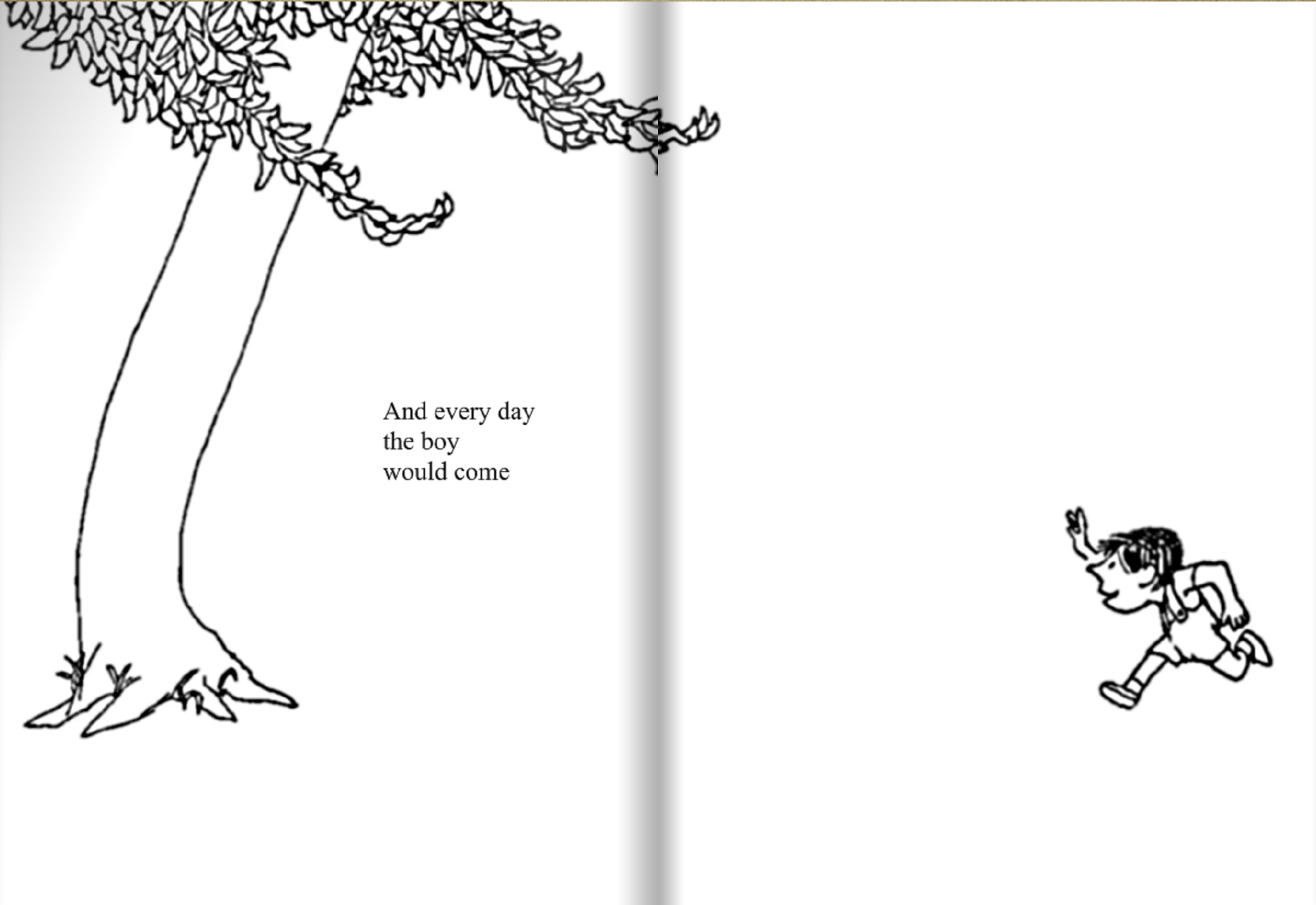
The Giving Tree is a children's book about a boy and a tree. Their relationship unfolds over a lifetime, with the tree continually giving more of itself to the boy until it's reduced to a stump.
I read The Giving Tree to my three-year-old recently, and I found myself thinking about how relationships in stories don't move in a straight line. They strengthen, drift, and sometimes come back.
As a researcher, I got curious about measuring those changes. You can feel them as you read but they're hard to describe, and even harder to quantify. Some would argue you shouldn't try—that the whole point of a story is to feel it.
I think you can do both.
Last week I surveyed 150 Americans (18+) and had them click through the story page by page. After each page, they picked from a set of overlapping circles—like the ones below—to show how close they thought the boy and the tree were.
You can take the survey here.
These circles are based on a scale developed by psychologist Arthur Aron in the 1990s to measure how close two people feel to each other. He called it the "Inclusion of Other in the Self" scale. (They may look familiar.)
I recruited 153 respondents through RepData, a survey vendor that draws from a large panel of Americans 18 and older. The sample is broadly representative — 52% female, 48% male — though because I run these surveys for fun rather than as formal research, I didn't enforce strict age or gender quotas. Take the results in that spirit — directionally interesting, but not a nationally representative study.
About 41% of respondents said they were familiar with The Giving Tree before taking the survey, while 59% were not. Statistically, familiarity didn't make much of a difference. Familiar readers rated the boy and tree as slightly more close on average (2.64 vs. 2.44 on a 1–5 scale), but that gap wasn't statistically significant.
What you're about to see is how closeness moves across the full arc of the story. The book is short—about 26 pages, most with just a few lines. The survey took around five minutes for respondents to complete.
Here's the results, with annotations showing when the boy and tree are close and apart, and how much time has passed.
What emerges from the data looks less like a story and more like a vital sign — a collective EKG of a relationship that plays out in under five minutes of reading. You can see the rhythm of it: closeness rising in childhood, flatlining through the long middle years of taking, and then that final, faint pulse at the end when the old man sits on the stump.
The 153 respondents don't agree on everything, but they agree on the shape. The relationship has a heartbeat, and the data picks it up.
Arthur Aron designed the "Inclusion of Other in the Self" scale to measure real relationships. But closeness isn't reserved for real people. We feel it toward characters, toward companies, toward brands we've grown up with and grown apart from.
The scale doesn't care whether the relationship is real. It just measures the distance. And distance, it turns out, tells you a lot — about what a story is doing to you, what a brand means to you, and where, exactly, things started to drift.
Brands use surveys to understand their customers. Most ask where people stand today. Few ask where things started to drift — or use questions built to surface that kind of answer.
If you want a second pair of eyes on whether your survey is actually capturing what you need, book a Survey Roast. Send me your draft, and for $145, I'll make a 15-minute Loom video with copy-and-paste edits and suggestions to improve your survey data quality.