
You Got This
It was two degrees in Brooklyn a few days ago—with a wind chill around negative fifteen—and I gave my six-year-old the following challenge:
Run into the backyard, through the snow, touch the grill, and run back.
Barefoot and in pajamas.
Before I opened the door, he took a deep breath and said, "You got this."
We rarely speak to ourselves in the second person. It’s reserved for moments when confidence wobbles—when we’re facing something we don’t think we can do. And sometimes, without realizing it, it’s how you hear your kid grow up a little bit.
The rest of the time, we operate in the first person.
Later that night, I did something much more forgettable: I took a survey about the New York gubernatorial election in November.
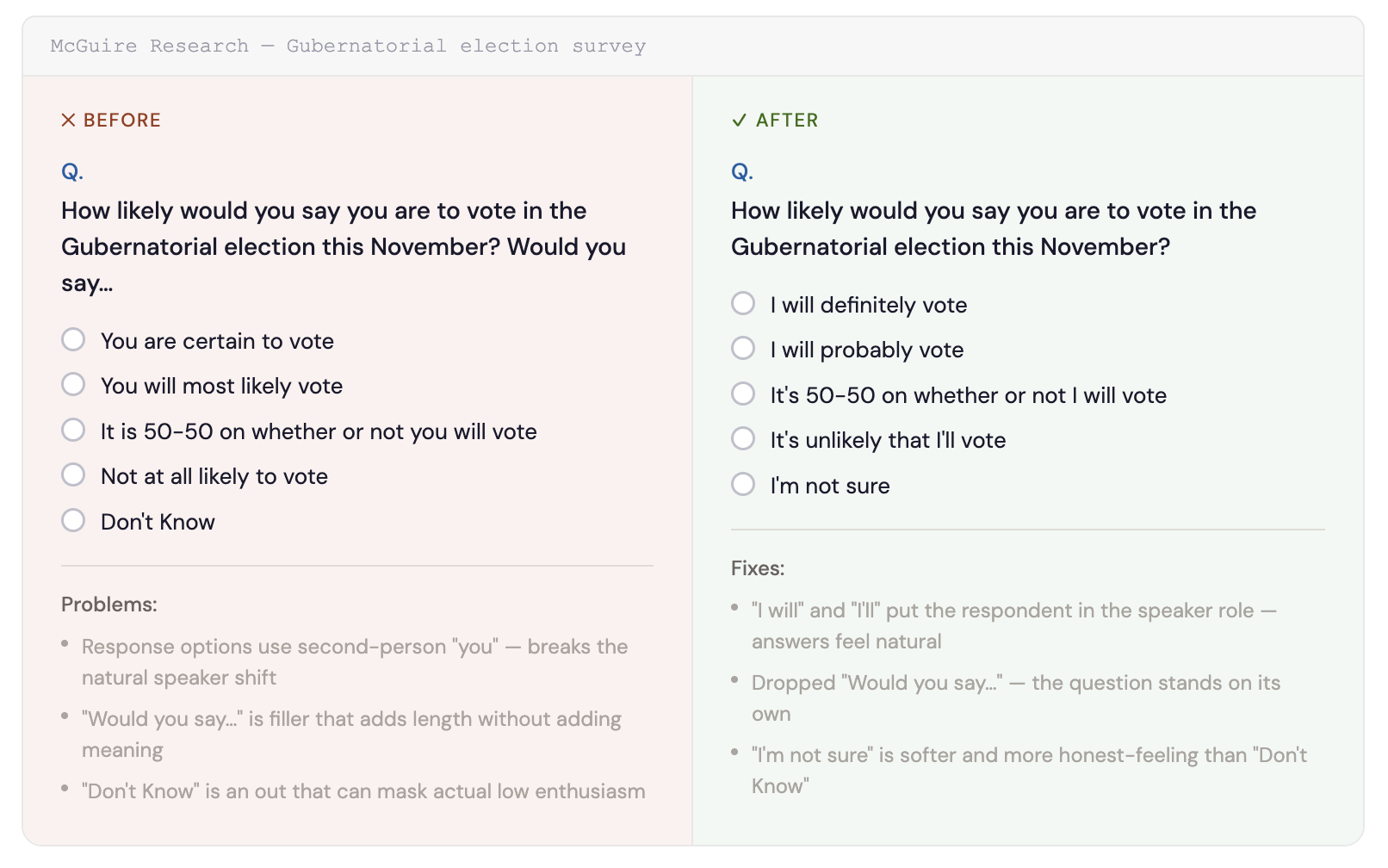
I got a text, clicked through a few warm-up questions, and hit this: “Even though it’s a long time away, how likely would you say you are to vote in the Gubernatorial election this November?”
The first option was “You are certain to vote.”
I paused.
The same "you.”
But this one was accidental.
Response options should be written in first person — "I am certain to vote” — because the respondent is answering for themselves.
Most marketing gets this voice right, so consistently that you probably don't notice it.
On a landing page, the brand is talking to you: "You deserve better sleep." On an FAQ page, you’re talking to the brand: "How do I track my package?"
The pronoun shifts with the speaker, like a microphone being passed back and forth in a Q&A.
Surveys are treated like measuring devices—we talk about scale reliability, question order, statistical validity—so it’s easy to forget they’re also an interface, a conversation between a marketer and a consumer.
Unlike a landing page, there’s no obvious feedback loop. If you write "You are certain to vote," the respondent still picks an answer. You still get the data.
The fact that "You are certain to vote" made the final draft suggests to me that no one else read it, or someone did read it — just not as a respondent.
And, if I'm being honest, that’s about 90% of what my Survey Roasts are.
I’m listening to your questions the way a respondent would. If a question is confusing, I’ll tell you.
You can do this yourself. Read your question out loud, then imagine handing a microphone to a respondent and asking them to read the response options.
Don’t imagine their answer.
Just imagine them reading each option out loud.
Do the words sound like theirs? If not, rewrite.
That'll catch the obvious stuff.
For everything else — the questions you've read so many times you can't hear them anymore — send me your draft. I'll record a 15-minute Loom video with clear, practical edits to make your questions easier for people to answer.
Cheers,
Sam
P.S. He made it to the grill and back. He ran inside and said, "I did it." Then my wife yelled at both of us (: