

The Annoying Index: Gym selfies, empty ice trays, daylight savings, the Dallas Cowboys.
Products that make annoying stuff less annoying are awesome.
By “products” I don’t mean disruptive technology like the personal computer.
I mean something like the Munchkin Faucet Extender — a small plastic attachment that redirects water toward the edge of the sink so toddlers can wash their own hands.
It’s two inches of molded plastic. Nearly 16,000 five-star reviews on Amazon. Likely a quiet, multi-million-dollar product.
We’ve got two.
Faucet extenders didn’t appear until the late 1990s. Not because the technology was complex — it’s plastic. The challenge was simply noticing that lifting a toddler to the sink, every single time, is annoying. Like the Invisible Gorilla, it’s obvious — but only if you’re looking for it.
I try to pay attention to what annoys me.
I gravitate toward CPG categories where I’m a real customer — or at least competing with products I use. Spotting friction in markets that don’t include me isn’t impossible. It’s just harder. (You see the same pattern in stand-up comedy: jokes drawn from lived experience usually land harder.)
I also assume my annoyance is unique, then work backward to prove myself wrong.
That step is tougher. Plenty of Shark Tank pitches fail because they solve a problem no one actually has, or one too small to matter.
Which brings me to this week’s newsletter.
Distinguish market-worthy annoyances from trivial ones
There’s a method that you can use to do this, in just an afternoon and for under $250.
It’s ideal if you are struggling to identify the most significant pain point from a list, lack the traffic for A/B testing, or want to avoid a “six figures and six months” research project.
How it works
I replicated the methodology last week across two surveys, each involving 150 participants (total respondent fee: $160). In keeping with the theme of this week’s newsletter, the surveys measured 17 things that annoy me including:
• Mismatched Tupperware lids and containers
• Running out of AA batteries
• The Dallas Cowboys
• Joggers who run in place at stop lights
Survey 1
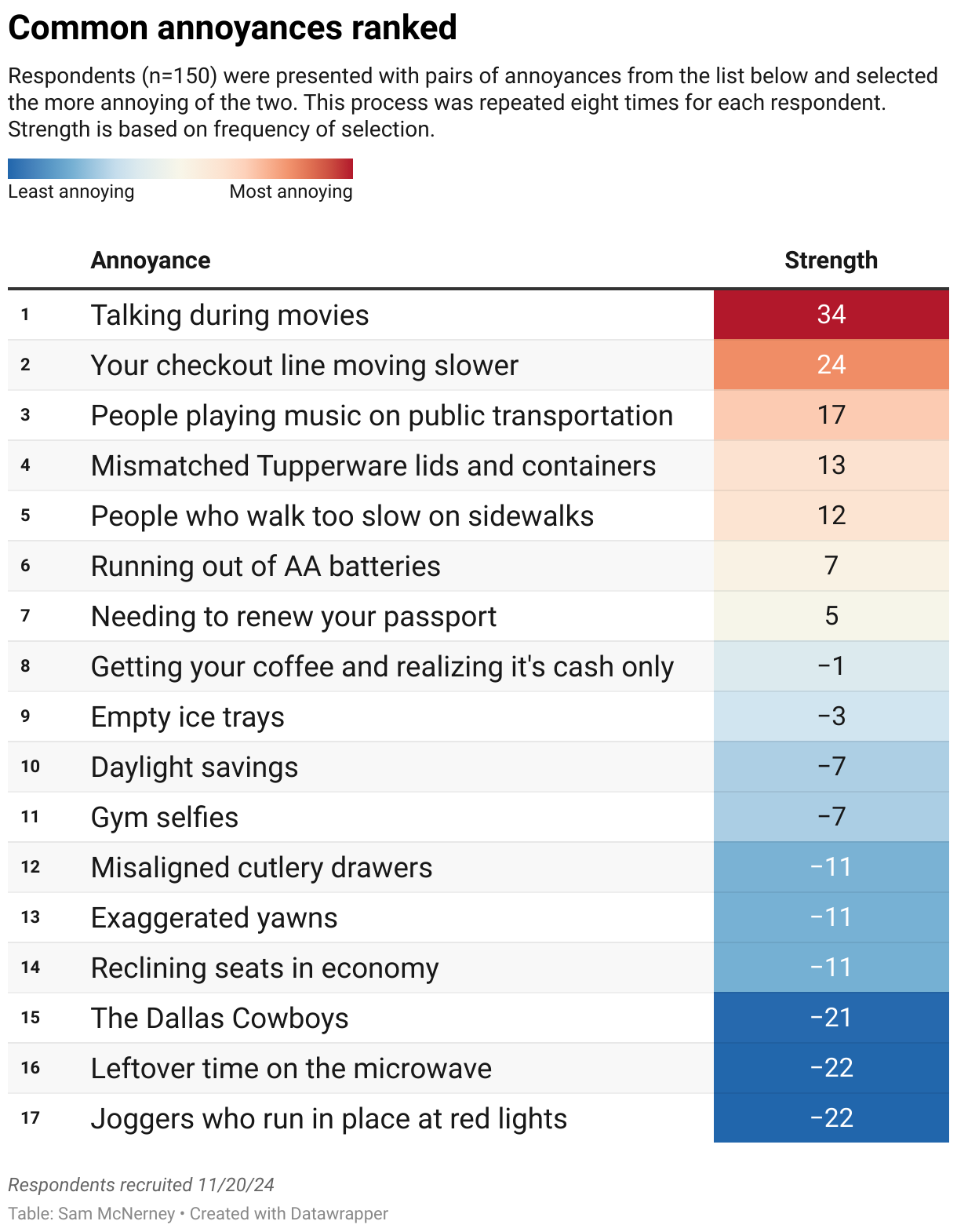
In the first survey, I showed each participant pairs of annoyances and asked them to select the more annoying of the two, then repeated the task eight times.
For the analysis, I measured the strength of each annoyance based on how frequently it was selected. For instance, “Talking during the movies” was chosen 84% of the time, so it got a “Strength” score of +34%, indicating it was selected 34% more often than the average.
(This is based on a methodology used here if you’re interested in the details, including how you can use it to do a segmentation, but don’t overthink it. It’s just a picking exercise.)
You can see the results below.
Survey 2
But how annoying is “Talking during the movies?”
Do other people hate it as much as I do?
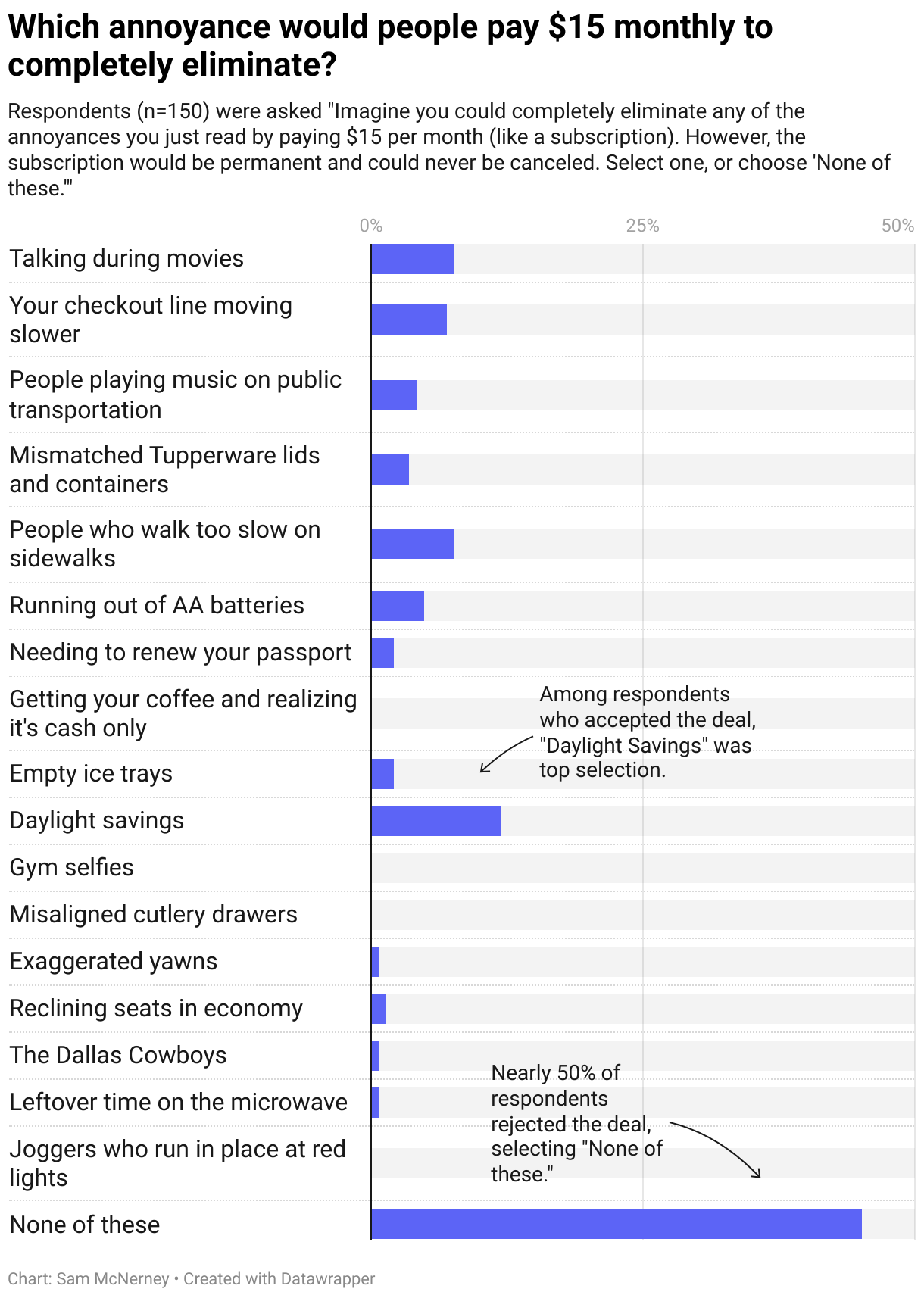
To find out, I had another group of 150 respondents read the same list of annoyances, but this time I offered them a deal: for $15 a month, they could permanently eliminate any annoyance of their choosing—but the subscription could never be canceled. They could pick one, or choose "None of these."
The steep price was meant to weed out anyone who wasn’t deeply troubled by any of the annoyances. Also, I’d take the deal for “Daylight Savings.” For me, paying $15 per month for an extra hour of sunlight every day is worth it.
What did everyone else do?
The most selected option by far was “None of these.” Among the alternatives, paying to eliminate “Daylight Savings” was indeed the most popular, but it was only chosen by 12% of respondents.
This result for me is the key point: Although most people probably agree that each item in the survey is annoying, few warranted a monthly fee for their removal.
People talking during movies is rare (in my experience) and mismatched Tupperware lids are irritating but tolerable. A slow-moving checkout line can be avoided by choosing the express lane, or just sucking it up. Other items, like slow walkers, the Dallas Cowboys, and Daylight Savings, are just part of life.
Could a different offer have changed the results?
Sure.
People might consider a one-time $15 surcharge for a talker-free movie experience, or opt for a $15 subscription if it included perks, such as premium seating and discounts on food and drinks.
You can easily tweak the deal, then retest with a new group of respondents, and continue until you can disprove your assumption.
That’s the point of the methodology – to quickly iterate.
(I linked to the data visualizations below. You can download and edit both.)
One last note
The 20th century was dominated by disruptive technology. Yet it’s hard to overstate how much “convenience products” shaped daily life.
Imagine waking up in 1950, in a middle-income household with kids. You head to the kitchen to prepare your kids’ school lunch. You accidentally leave the fridge open but it doesn’t beep. You look for Tupperware but it’s not there. No garbage bags with drawstrings.
It’s a hellscape.
There are thousands of inconveniences still out there, fully visible yet "hidden," like the Invisible Gorilla.
‘Steal-This’ Resources
You’ll need a free Data Wrapper account to download and edit these.
• Data visualization one
• Data visualization two
Next Steps
If you’re considering creating a survey, but you’re unsure about your approach, then consider getting a Survey Roast.
Send me your survey draft, and for $145, I’ll make a 10-15 minute Loom video with copy-and-paste edits and suggestions.
I’d love to help.
Cheers,
Sam