

Never buying lube and condoms at the self-checkout kiosk again
For years, whenever I scanned an item at the self-checkout kiosk at CVS, the machine would freeze.
I’d set the item down on the shelf in front of me—because that’s where your hands naturally go—but the kiosk wouldn’t let me scan the next item.
The problem reared its ugly head one night when I was buying lube and condoms and the “help is on its way” call was triggered.
I panicked and left before the employee got there.
That was about five months ago, and last week I realized what I was doing wrong.
Before you scan the next item, you have to either press “Skip bagging” or place the item in the bagging area off to the side. You can’t just keep scanning.
I guess I'm used to modern interfaces just working. Nearly 40 years after Don Norman’s The Design of Everyday Things, in the era of the iPhone, I expect those kiosks to be as seamless as one-click ordering.
And yet, despite the progress, this basic expectation of intuitive design still hasn’t reached the survey world — partly because it acts like an island that forbids visitors.
For example:
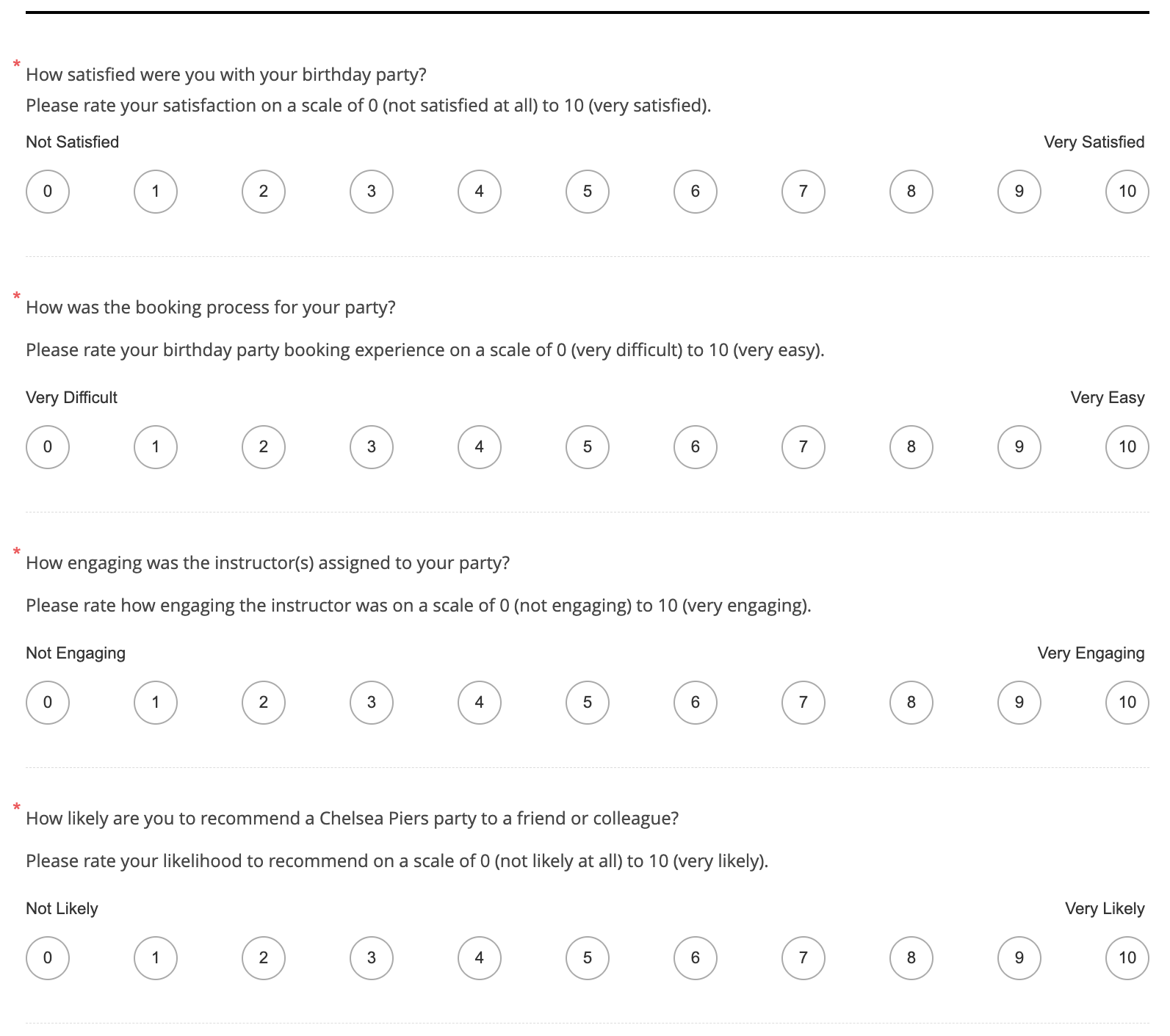
Back in October, after my son’s sixth birthday, I got a feedback survey (below) from the field house that hosted the party.
I noticed an easy way to remove friction: 72 words could be cut without changing a single question. (A full 33% of the total text.)
Under each question, they added this line:
“Please rate your [item] on a scale of 0 (not satisfied at all) to 10 (very satisfied)”
You don’t need this text. The moment you see a 0–10 row with labels “Not satisfied” and “Very satisfied”, you know what to do. It’s like Amazon putting a popup on the Buy Now button that says “Click here to purchase.”
The problem is that quant research culture rewards adding more: more instructions, more clarifications, more guardrails. In corporate environments, this incentive gets amplified: you’re praised for anticipating every hypothetical misunderstanding, as if thoroughness were the same thing as good design.
But respondents don’t care about any of that. Like any user, they just want the experience to be easy.
The lube and condoms could still be sitting on the CVS kiosk, abandoned because the machine didn’t know that when I scanned the lube, I wanted to scan the condoms and leave as quickly as possible.
And somewhere, someone is abandoning that field house survey because they got tired of re-reading the same instruction.
Interfaces work best when they get out of the way.
Surveys included.
And if you want help making your survey feel intuitive instead of over-explained, consider booking a Survey Roast.
You’ll get more completions and cleaner data the same way a well-designed checkout gets more people through the line.
Send me your survey draft, and for $145, I'll make a 15-minute Loom video with copy-and-paste edits and suggestions to improve your survey data quality.
Cheers,
Sam