

Three questions Gallup would never ask
For eight decades, Gallup has asked Americans the same question: "Do you approve or disapprove of the way the president is handling his job?" Last month, they announced they're retiring it.
Gallup built its reputation on consistency.
But consistency has a cost. When the format never changes, neither does what you can learn from it.
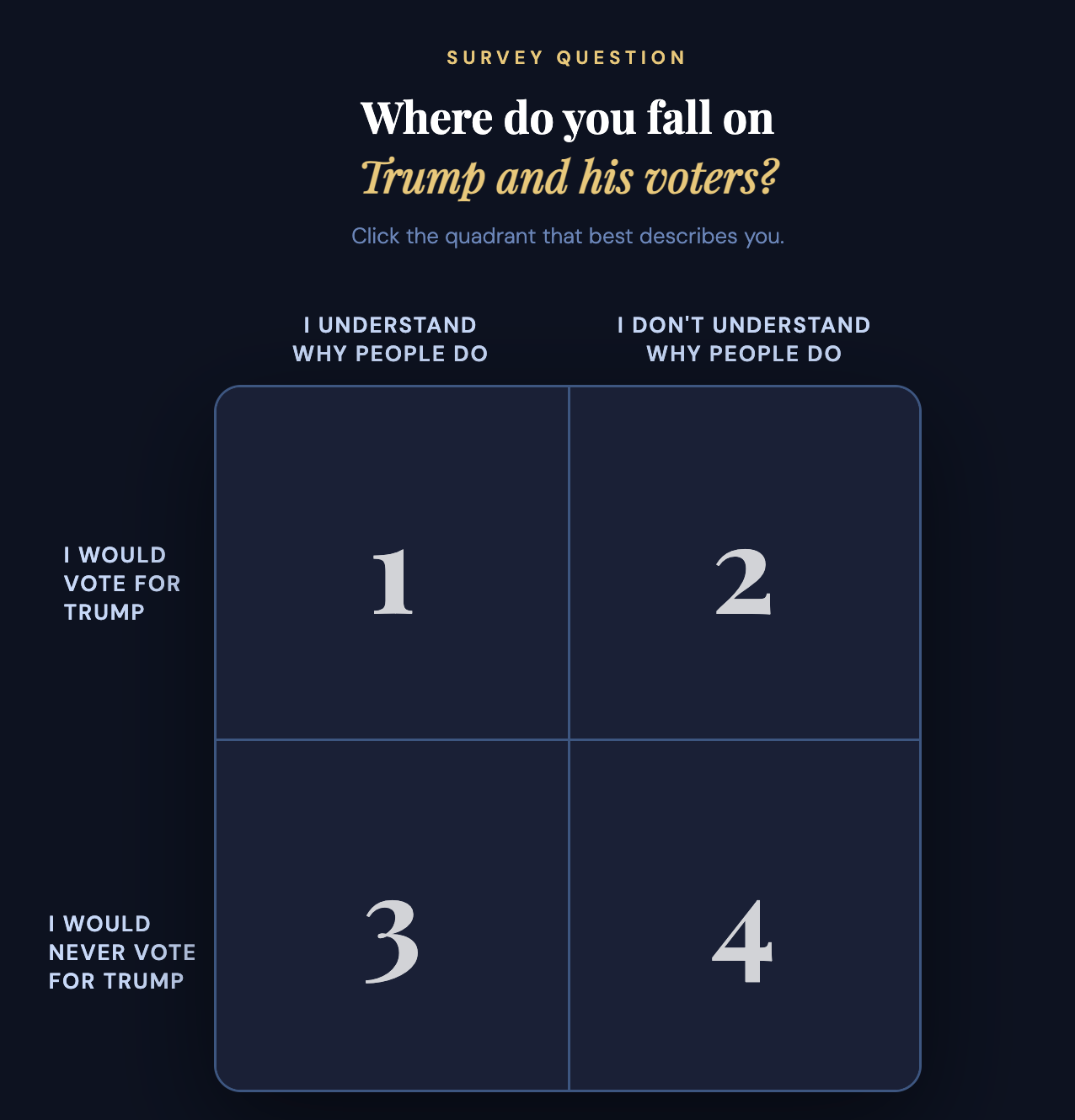
This week, instead of asking people if they approve or disapprove of Donald Trump, I asked people which Venn diagram best captures how much their politics overlap with his, if they'd sit next to him on a plane, and where on a grid they fall relative to his voters.
For each question, I built a custom interface: a row of seven circle pairs, an airplane seat map, and a 2x2 grid.
You can spend a week optimizing a question and learn incrementally more. Or you can change the interface and access something the original question never could have.
Here’s what I found:
Test 1: The Venn diagram question
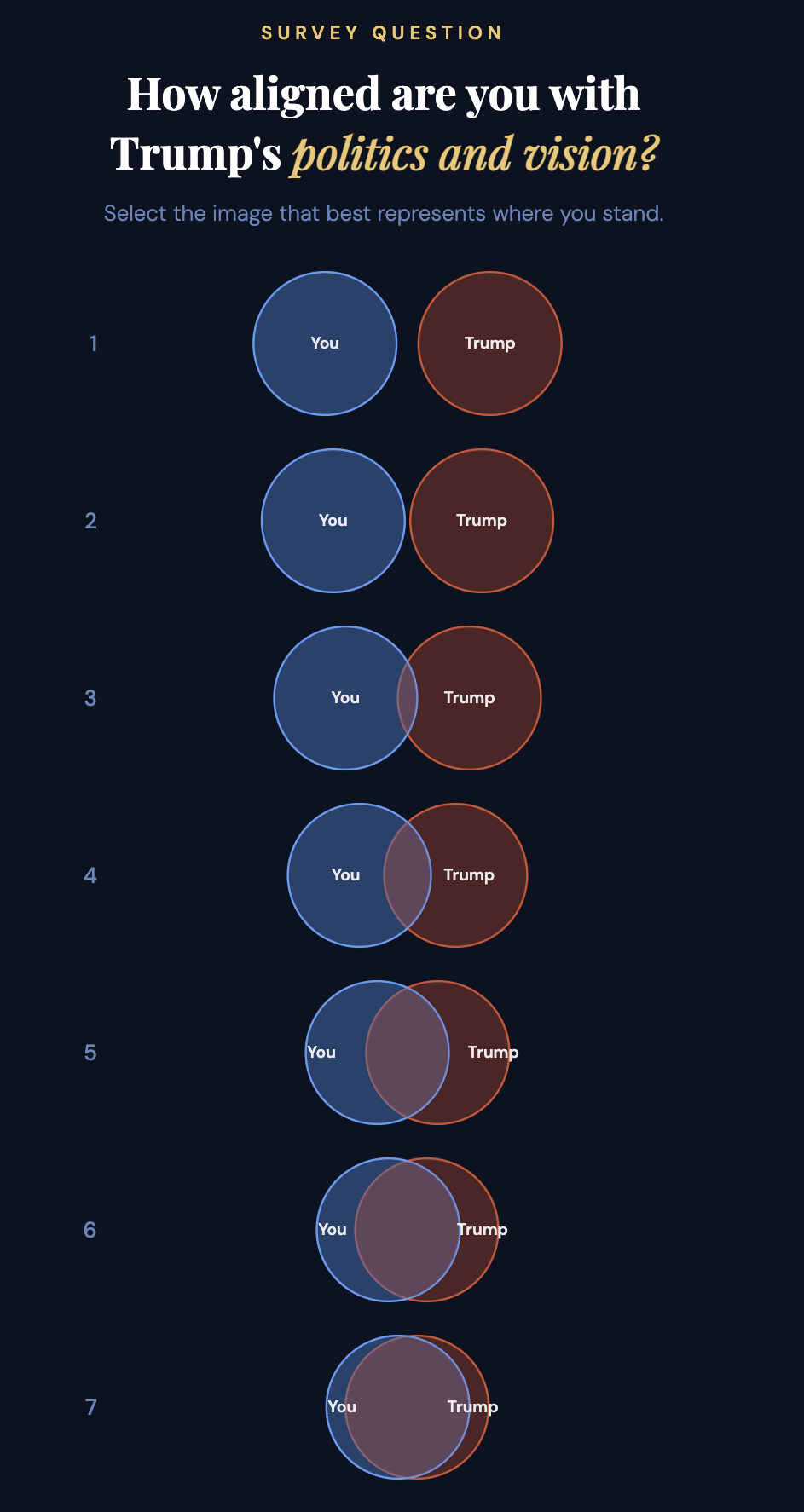
In the early 1990s, the psychologist Arthur Aron created a method for measuring how close two people feel to each other: a row of circle pairs, ranging from fully separate to nearly overlapping. He called it the “Inclusion of Other in the Self” scale.
Aron's circles were built for interpersonal closeness. I borrowed them to measure ideological proximity.
How much does your worldview overlap with Trump's? Not whether you like him, not whether you'd vote for him — but how much of the same conceptual territory do you occupy?
A five-point approval rating asks you to evaluate Trump from the outside. The circles ask you to locate yourself relative to him. It’s different. You're not judging. You're mapping.
How aligned are you with Trump's politics and vision?
Weighted to Pew 2025 party distribution · Results by political affiliationTest II: The airplane seat map
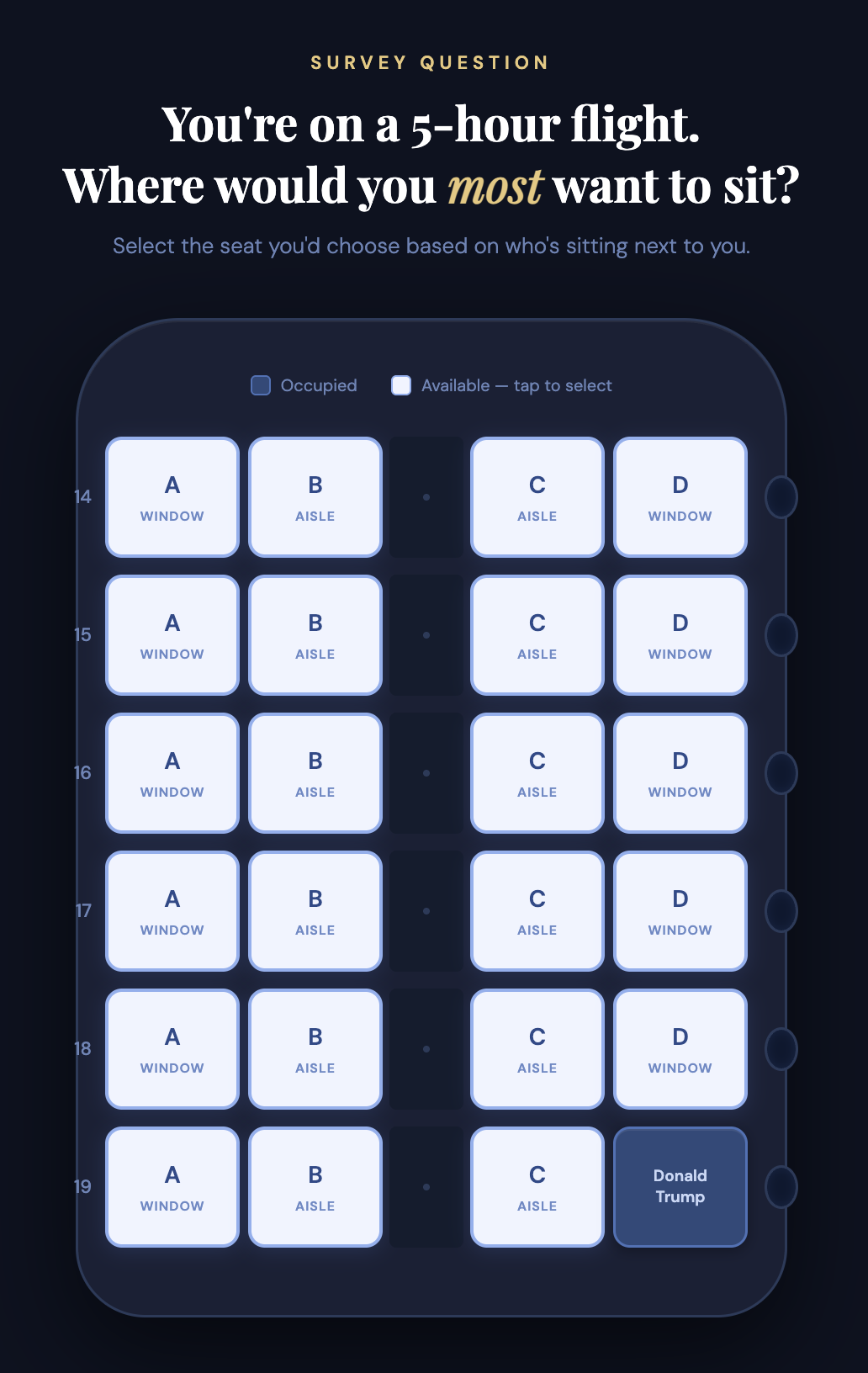
The comedian Mark Normand has a bit about flying. What if you could pick not just where you sit, but who you sit next to — dating app style?
"Obese Nazi with a service dog. Swipe left. Tiny Asian lady with a surgical mask. That's my gal…. "
I’m with Normand. I’d swipe right for someone who would leave me alone for five hours.
But Trump?
He's the one seatmate who might actually be worth five hours of conversation — or at minimum, five hours of observation. You could ask him anything. You could say nothing and just watch. Either way, you're getting off that plane with a story.
Here's where people chose to sit.
You're on a 5-hour flight.
Where would you most want to sit?
Seat fill shows % who chose that seat · Color = party breakdown
Test III: The voter matrix
Eric Weinstein talks about xenophilic restrictionists — people who love other cultures but supports stricter immigration limits. His point is that the position only looks contradictory because the existing label system has no room for it. So it gets flattened, miscounted, or ignored entirely.
The 2x2 is built on the same logic.
Two axes: would you vote for Trump, and do you understand why people do?
Most people assume these track together — Trump voters get Trump voters, everyone else doesn't. But separating them creates space for a position that a single axis erases: people who would never vote for him but can nonetheless articulate why others do. That's not a contradiction. It's a distinct, coherent political identity that simply has no home in the approve/disapprove framework.
Approval ratings collapse both dimensions into one number. You're either for him or against him — the question of whether you understand him never gets asked. That's the gap this question was designed to find.
Here's what I found.
Where do you fall on
Trump and his voters?
Fill height = % who selected that quadrant · Color = party breakdown
vote for
Trump
never vote
for Trump
why people do
why people do
The conventional obsession in survey design is wording. But the interface — how a question is experienced, not just read — is another source of insight.
That’s exactly what I look for in a Survey Roast.
For $145, send me your survey and I’ll send back a 15-minute Loom and a Google Doc with copy-and-paste edits and suggestions to make it clearer, easier to answer, and more likely to produce useful data.
You can see an example here.
Cheers,
Sam