
Humans vs. Robots:
Where Do You Stand?
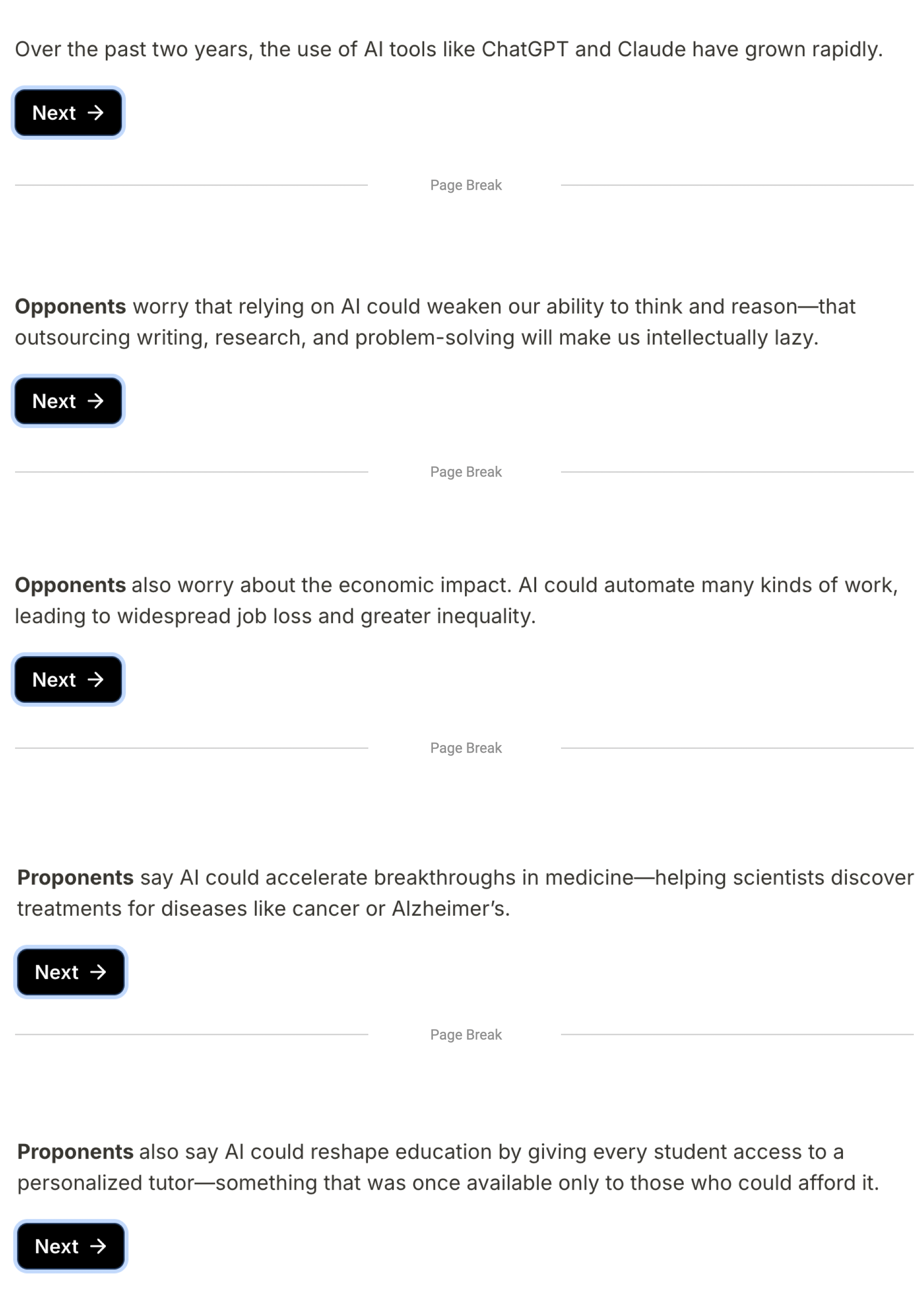
Over the past two years, AI tools like ChatGPT and Claude have grown rapidly.
Some people worry that relying on AI could weaken our ability to think and reason — that outsourcing writing, research, and problem-solving will make us intellectually lazy.
Others worry about the economic impact. AI could automate many kinds of work, leading to widespread job loss and greater inequality.
At the same time, AI could accelerate breakthroughs in medicine — helping scientists discover treatments for diseases like cancer or Alzheimer's.
And AI could reshape education by giving every student access to a personalized tutor — something that was once available only to those who could afford it.
Given these different perspectives, where do you stand on AI today?
That's the question we asked 232 people — after they read exactly what you just read.
Here's how they answered.
help society
harm society
Then we shifted the frame. Instead of society, we asked about individual lives. But first, we gave people four short stories.
After a semester of using AI to write her essays, a college student sat down to write a cover letter on her own and couldn't organize her thoughts. "It was like a muscle I'd stopped using," she said.
A freelance graphic designer lost three long-term clients in one year after they all switched to AI-generated designs. He's now retraining in a completely different field at age 41.
An AI system analyzing genetic data flagged a treatment pathway that a woman's doctors had missed for years. Within months of starting the new treatment, her symptoms improved dramatically.
A student in a rural town with no AP courses used a free AI tutoring tool to learn calculus, prep for the SAT, and revise his college essays. He became the first person in his family to get into a four-year university.
Now thinking about your own life, do you believe AI will be mostly good or mostly bad for you personally?
good for them
bad for them
Two questions. Two splits. But the interesting part isn't either answer on its own — it's what happens when you put them together.
optimistic for themselves
pessimistic for themselves